
This week, the STEM lab transformed a traditional physics experiment into a deeper investigation of scientific validation. Guided by the question – Why do objects feel lighter in water? students explored buoyancy through the principle introduced by Archimedes, but with a modern, inquiry-driven approach.
In a conventional lab, buoyancy is demonstrated using a spring balance, where students observe the difference in weight of an object in air and in water – offering a strong foundational understanding of the concept.
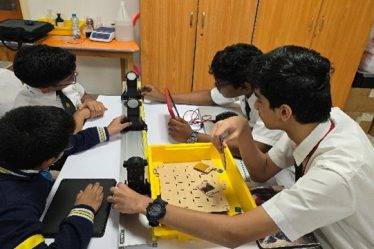
Building on this foundation, students in this activity moved towards precision-based verification. Using PASCO Force Sensors integrated with SPARKVUE, they captured real-time force data during immersion, allowing them to visualize continuous changes and engage with the concept at a deeper, data-driven level.
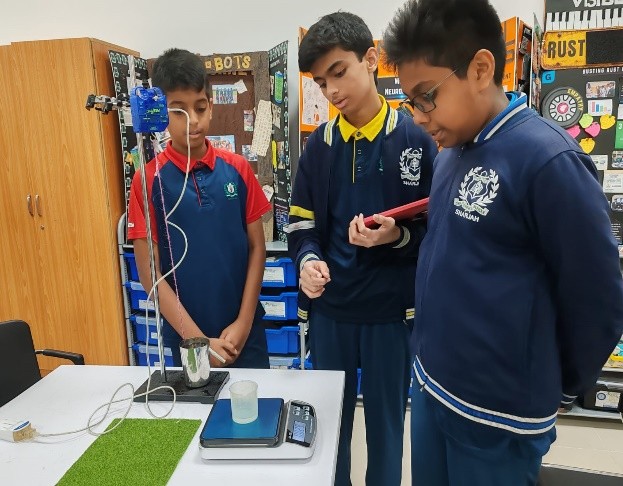
To strengthen their findings, students applied a dual-verification method. Alongside digital measurements, they collected and weighed the displaced water to independently calculate the buoyant force. By comparing both sets of results, they engaged in evidence-based reasoning, ensuring that their conclusions were supported through multiple approaches.
Moments of mismatch between readings were not treated as errors to avoid, but as opportunities to learn. Students examined possible sources of inaccuracy, refined their methods, and repeated trials. This process helped them understand that science is not about getting immediate answers, but about testing, questioning, and validating results.
By the end of the activity, students did more than confirm a scientific principle. They developed a deeper appreciation for how knowledge is built – through accuracy, comparison, and critical thinking. This experience highlights that innovation in STEM is not just about using advanced tools, but about transforming how students think. It shifts learning from “seeing what happens” to asking:“ How do we know this is true – and how else can we prove it?”
Anusha Madanagopal