
“Every child has a story-sometimes, they just need help finding the first word.”
Creative writing- two words that sound exciting, imaginative, and full of possibility. Yet, in my Grades 3, 4, and 5 classrooms, it often began very differently.
“Ma’am, what should I write?”
“I don’t have any ideas.”
“Can you give me the starting line?”
That’s when I realized – creative writing wasn’t just a task for my students. It was a moment of hesitation. A blank page that felt too big, too silent, and sometimes… a little intimidating.
What worked for me? Giving them permission to be imperfect.
The turning point came when I stopped focusing on how well they wrote and started focusing on how freely they expressed. We began small.
One picture. One sentence. One silly idea.
“What if your pencil could talk?”
“What if you woke up invisible?”
“What if your school had no rules for a day?”
The classroom slowly shifted. There were laughter, unexpected ideas and stories that didn’t always make perfect sense—but they were alive.
One student once wrote,
“My cat is a secret superhero, but only at night when I am sleeping.” Grammatically imperfect – but wonderfully imaginative.
And that was the moment I knew – this was working. The challenges? Quiet but powerful.
Many students were afraid of being wrong. They worried about spelling, punctuation, and whether their ideas were “good enough.” Some wrote just two lines and stopped. Others kept erasing, trying to make every word perfect.
The biggest challenge wasn’t writing it – was confidence.
I had to constantly remind myself: creativity cannot grow under pressure. It needs space, encouragement, and sometimes… a little chaos.
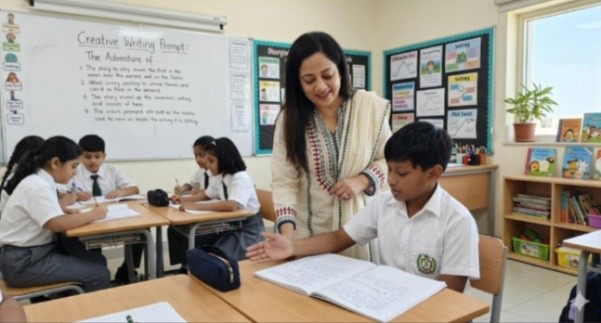
The most important lesson I learned. Ideas come before accuracy. When students feel safe to express without fear of correction, their thoughts begin to flow. The structure, grammar, and refinement can come later—but the voice must come first. So now, in my classroom, creative writing is no longer about filling a page. It’s about unlocking imagination.
Because behind every “I don’t know what to write” is a child waiting to discover that they have so much to say.
And all they really need……………is someone to tell them it’s okay to begin.
Sadaf Arshad – Faculty English