
It began late in the evening….. when big decisions arrive and sensible people are preparing to sleep.
A message came in.
School would be online, effective immediately.
My first reaction? Not strategic. Not visionary. Not even remotely “principal-like.”
“Wow… no 5:10 a.m. alarm.”
That joy lasted exactly 12 seconds.
Then reality logged in.
Because the next thought was not about sleep. It was about 5,500 students, hundreds of teachers, anxious parents and one very large question:
How do we make tomorrow make sense?
A quick check.
Systems? In place.
Technology? Ready.
Plans? Drafted.
But the shift from onsite to online isn’t really about technology. That part behaves. Links are shared, platforms open, and yes-quiet gratitude to Microsoft Teams, a name I began hearing more often than my own.
The real challenge is far less cooperative: human inertia.
That night turned into a blur of action – messages sent, meetings scheduled, roles clarified, protocols aligned. But more than that, it demanded something less visible – calm.
Because, in that moment, it wasn’t just about getting things done. It was about projecting confidence when everything felt uncertain, reducing anxiety before it spread, and ensuring that, even when answers weren’t complete, reassurance was.
The next morning began with surprising enthusiasm.
I found my “ideal workspace”-a comfortable chair, soft sunlight, a view of the garden, birds providing background music as if they, too, had joined the schedule. For a fleeting moment, it felt like an upgrade.
And then came the real highlight.
My dog, Barfi, took his place beside me-thrilled that I was home and promptly appointing himself my assistant. His constant “thumbs up” came in the form of a wagging tail, quietly assuring me that everything would be fine-especially on days I wasn’t so sure.
Day one had begun. And it felt… almost too smooth.
That illusion didn’t last.
Because, very quickly, the screens began to reveal what no timetable captures—emotion.
A pause before speaking.
A careful tone.
That unspoken question: “Are we doing this right?”
And so, we spoke. We listened. We reassured.
Sometimes, it isn’t about having all the answers. It is about holding space-with patience, with consistency, and with the willingness to listen even when you yourself are still figuring things out.
And then came our youngest learners.
Kindergarten.
Three- and four-year-olds whose grand introduction to school was… a floating face on a screen asking them to “mute and unmute.”
What followed was not a challenge-it was a masterclass in unpredictability:
A child attending class horizontally (asleep, but technically present).
A parent attempting to feed milk during phonics.
Another proudly introducing a dinosaur mid-counting lesson.
If ever there was a moment for humility, this was it.
And yet, slowly, beautifully, order emerged. Teachers designed routines, set expectations, experimented, adapted-and did what great educators always do: they made the impossible feel normal.
If resilience had a live demonstration, it was in those kindergarten classrooms.
As weeks passed, a few unexpected truths quietly settled in.
First, there is something deeply reflective about speaking for hours and hearing only your own voice. It makes you think – about your content, your delivery, and occasionally, your life choices.
Second, the absence of corridors matters more than expected. In school, you walk between spaces, reset your mind, and breathe. Online, there is no walking – only clicking. One meeting ends, another begins, and before you know it, time has politely excused itself from the room.
And third, professionalism became very practical – camera on, smile ready, and everything beyond the frame… negotiable.
But beneath the humour, something deeper was taking shape.
Showing up every day.
Listening before leading.
Offering steadiness even on days you didn’t quite feel it yourself.
And then, one day, we returned.
Not just to classrooms, but to something we had missed more than we realised—
a high-five in the corridor,
a shared laugh,
a smile that didn’t freeze or buffer.
Because for all its efficiency, no screen can replace the energy of being together.
And through it all, in the UAE, uncertainty never quite became fear – there was always a quiet reassurance around us, a steady sense of safety that allowed us to focus on what truly mattered.
If this journey taught us anything, it is this:
the future may be unpredictable, plans may change overnight—
but when we move together, we never lose direction.
We come out the other side, closer than when we went in.
And that, in the end, is what truly matters.
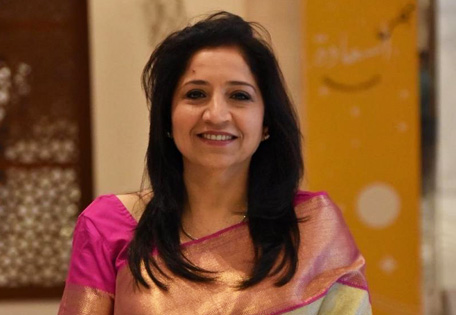
Vandana Marwaha – Principal and Director